
Happy Lottery Day!
To all those who celebrate—you know who you are.

“The morning of June 27th was clear and sunny, with the fresh warmth of a full-summer day …”
Thinking about Shirley Jackson, and the story that changed both her life and American literature forever, on the day that has become known as “Lottery Day.” Below, a capsule history of that story, told via photos from my archive.
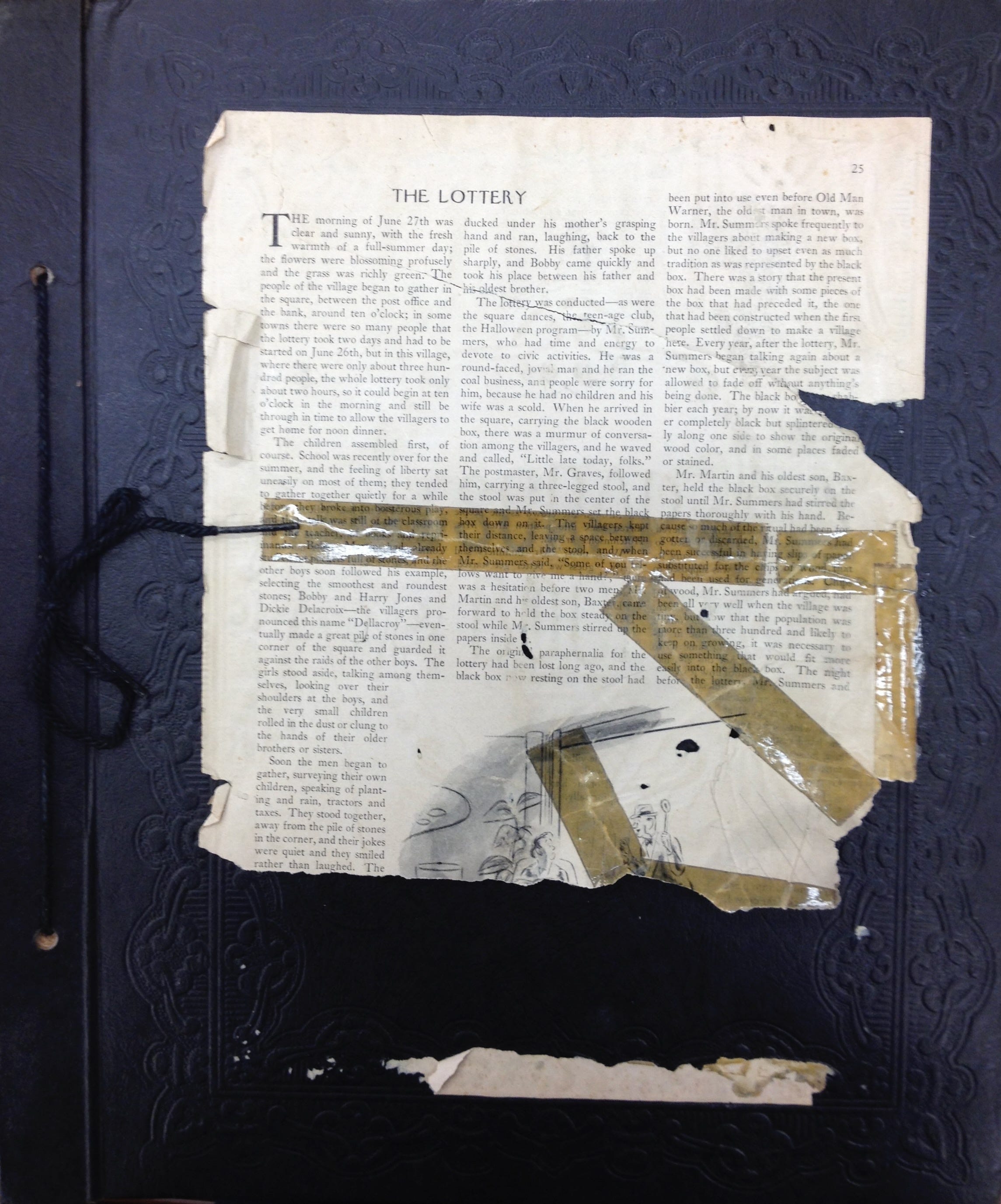
1. The battered cover of a scrapbook where Jackson collected some of the letters she received in response to the story, which The New Yorker published in its issue of June 26, 1948. Jackson originally wrote and submitted the story in the spring, but when its publication was delayed, New Yorker editor Harold Ross wanted her to change the date on which it was set to match the season. The first draft has been lost, so we don’t know what the original date was.
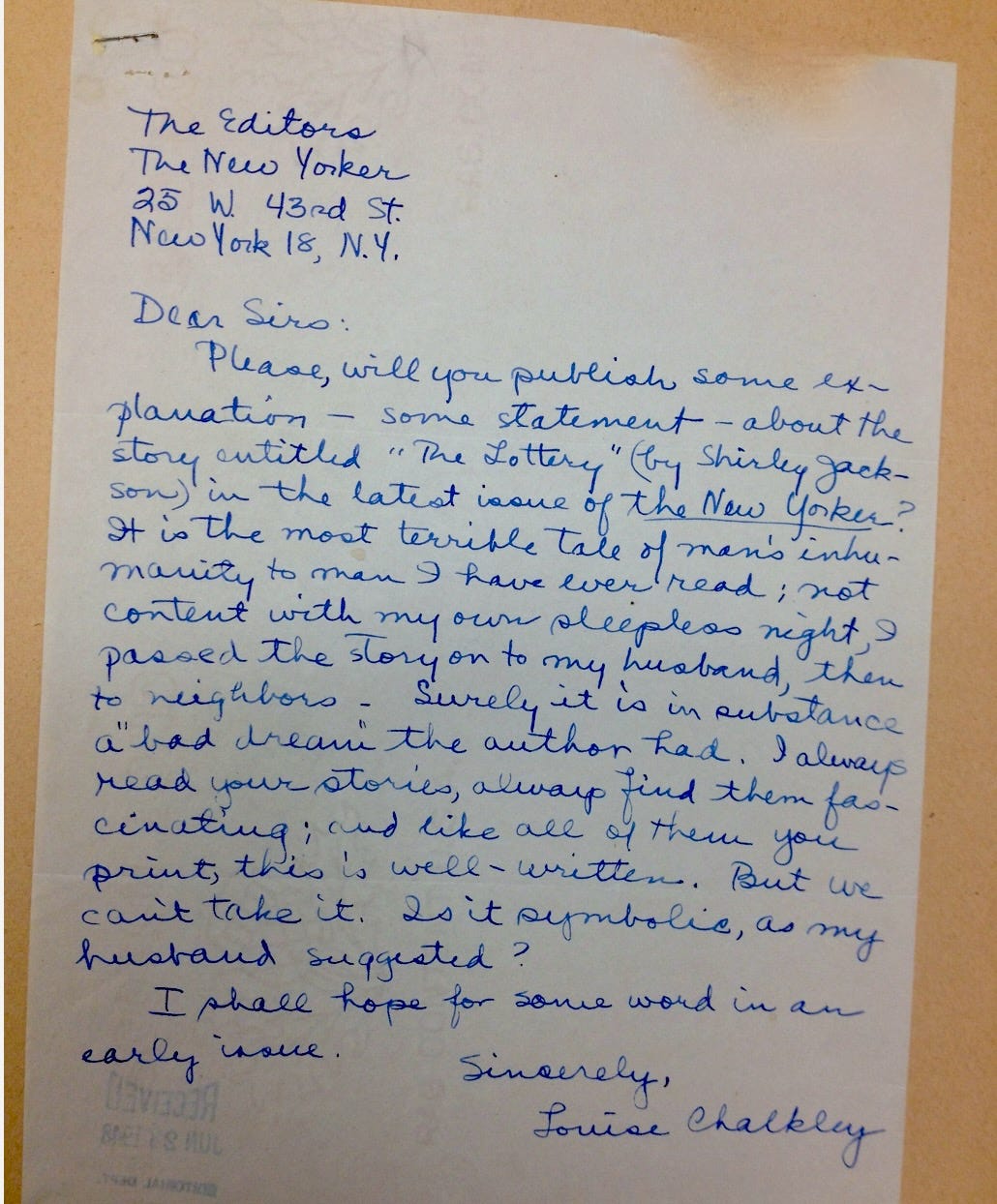
2. One of those letters, which would eventually number in the hundreds. Jackson later claimed that they were dominated by three main themes: “bewilderment, speculation, and plain old-fashioned abuse.” Some readers wanted to know where such lotteries were held, and whether they could go and watch; others threatened to cancel their subscription to the magazine. But most, like this writer, just wanted to know what the story—“the most terrible tale of man’s inhumanity to man I have ever read”—was supposed to mean. “We can’t take it. Is it symbolic, as my husband suggested?” I love the image of this reader passing this story around to her friends and family, asking each what they thought it meant.
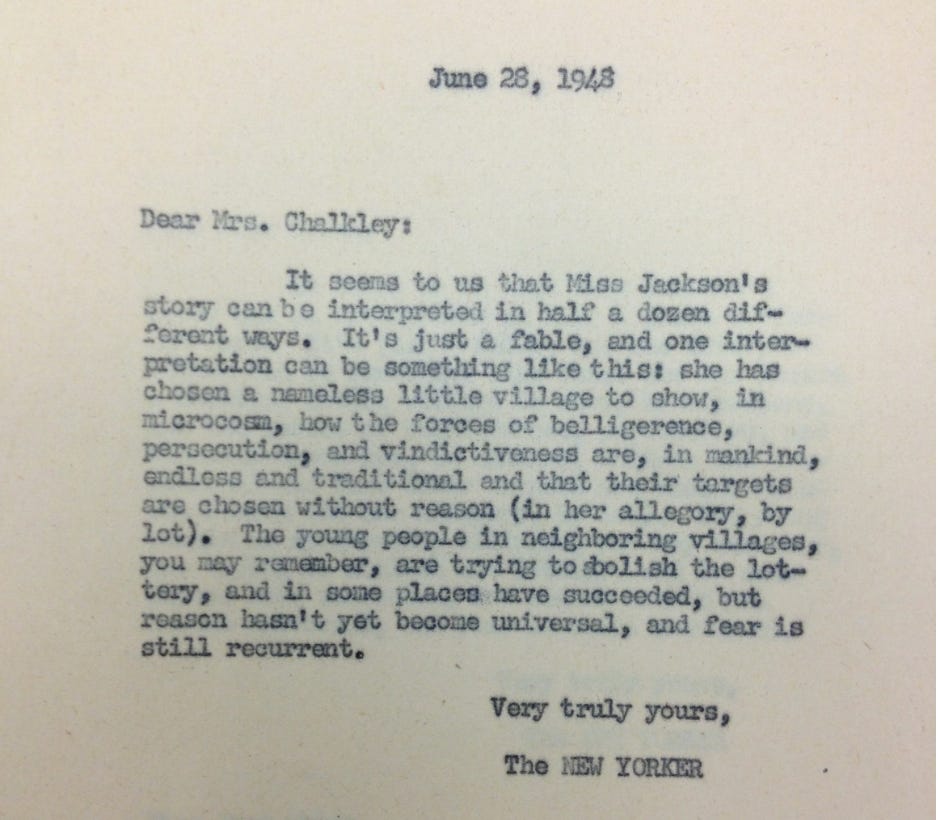
3. The New Yorker’s form letter in response to these letters: “It seems to us that Miss Jackson’s story can be interpreted in half a dozen different ways …” Jackson herself famously gave at least half a dozen explanations of it to different people: it was about small-town life in North Bennington, the Vermont town where she was living, or elsewhere in New England; it had to do with the Holocaust, or antisemitism in general; it traced its genealogy back to The Golden Bough and the myth of the scapegoat. My favorite of these answers is one she once gave to a high school student, the friend of one of her children: “If you can’t figure it out, I’m not going to tell you.” But she approved this message from The New Yorker, which was written by Kip Orr, a young staffer at the magazine.
4. Jackson reading “The Lottery” during a lecture in Michigan in July 1962. By this point, “The Lottery” had already become one of the most frequently anthologized stories in American literature, especially for high school textbooks. It’s been adapted for TV (several times), opera, ballet, and film. Despite the substantial earnings it brought her, Jackson feared it would overshadow her other writing. At once point, she asked her agent to raise the permissions fee to encourage editors to “let the poor old chestnut rest for a while.” The price hike only brought in more money.
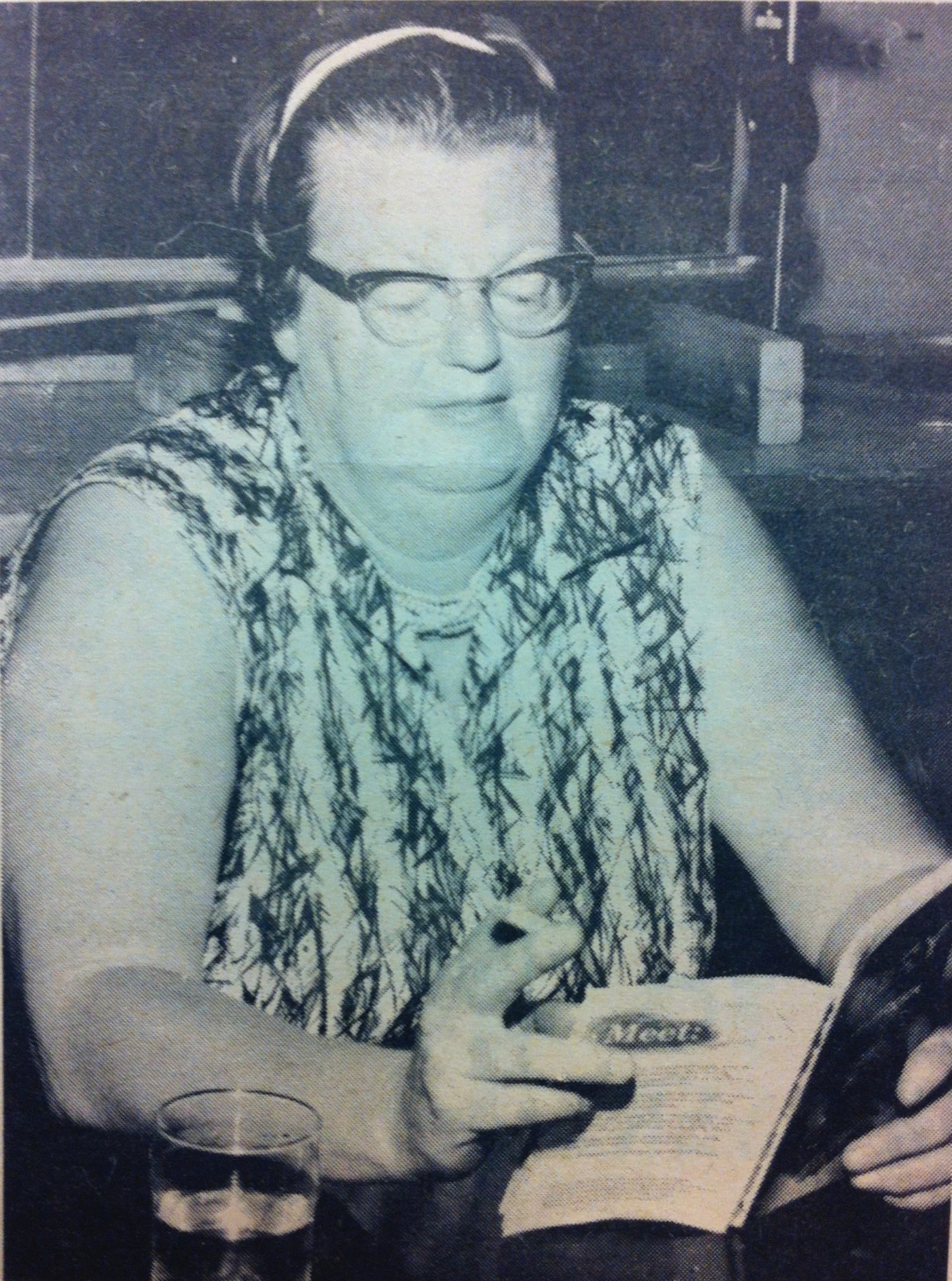
In 1959, Jackson recorded the story for Smithsonian Folkways, along with “The Daemon Lover.” Those recordings are the only publicly available audio of her voice. Jackson’s son Lawrence Hyman made them on a reel-to-reel recorder. Nervous, Jackson kept a glass of bourbon next to her as she read. If you turn up the sound, the clink of ice cubes is occasionally audible.
As we approach the 10th anniversary this fall of Shirley Jackson: A Rather Haunted Life, I’ll be posting more of these outtakes from my biography as well as new reflections on Jackson’s life and legacy. Do you have unanswered questions about her you’d like me to tackle? Let me know in the comments.
Where I’ll be
Online, July 25, 1-3 p.m.: I’m hosting a single-session workshop, “Write Like a Mother: Finding Your Voice After Having Children.” It reframes motherhood as a creative opportunity rather than an obstacle, as well as offering practical strategies for organizing time and work. We’ll look at passages on parenting and art from brilliant mother-writers like Shirley Jackson, Audre Lorde, and Ursula K. Le Guin, and discuss how to keep our work moving forward when life is unpredictable and exhausting. Sign up here.
In person: New York, July 26, 2 p.m.: I’ll be in conversation with my friend Heather Clark, author of Red Comet: The Short Life and Blazing Art of Sylvia Plath and, most recently, the novel The Scrapbook, which deals with the aftermath of the Holocaust two generations later. Details here.
What I’m reading
On the recommendation from the Books newsletter of the Sunday Times (of London), my favorite book-review newsletter, I devoured Sophie Mackintosh’s beautiful, mysterious Permanence, an impressive new addition to one of my favorite genres: the adultery novel. One morning Clara wakes up with Francis, her married lover, in an apartment in an unknown city. Everything seems to be designed for their comfort and pleasure: the furnishings in the apartment, the coffee in the kitchen, the books on the shelves. They soon discover that the city is filled with couples just like them, snatching a moment of joy together before returning to their everyday lives. Can this go on forever? Would they want it to? Mackintosh is superb at delineating not just the intoxication of an intense affair but also the constellation of moral and ethical issues for all involved.
I met you at a book signing at The Mount In Lenox yrs ago
We chatted as you signed my copy of your book and I shared with you that I grew up near her in North Bennington
I went to school with
her children and often heard her around town .. in Power’s market , sharing conversation with my gram who was secretary for the music and dance division at the college or she came to our Girl Scout troop to talk about writing
What I want to say is I always thought her speaking voice was distinctive and hearing this recording of her voice pleased me today no end
Thank you 🙏
Deborah
Wondering what ever happened to the marvelous Kip Orr. What a respectful and profound response. And the clinking ice cubes are a delicious detail.