
Making your own luck
What I learned from the letters in the barn.

One afternoon while I was working in Shirley Jackson’s archive at the Library of Congress, I came upon a folder of letters from a woman named Jeanne Beatty. I had flipped past it before—the name didn’t ring any bells—but that day, something made me stop and open it.
There were about a dozen letters, chatty and affectionate, starting with a fan letter responding to an essay in which Jackson lamented the current state of children’s literature: magical kingdoms were out; practical, inspirational stories were in. “Every now and then,” she had written, “even these days, I meet someone else who knows the names of the four countries of Oz…. There are fewer of us every year, I suspect.”
Jeanne’s letter listed those four countries (Gillikin, Munchkin, Quadling, Winkie) and came with gifts: a Moomin book by Tove Jansson and another called Palm Tree Island, “better than Treasure Island.” It showed that Jeanne, a Baltimore housewife, was a kindred spirit. In addition to knowing the Oz books just as well as Shirley did, she was clearly starving for someone to talk to.
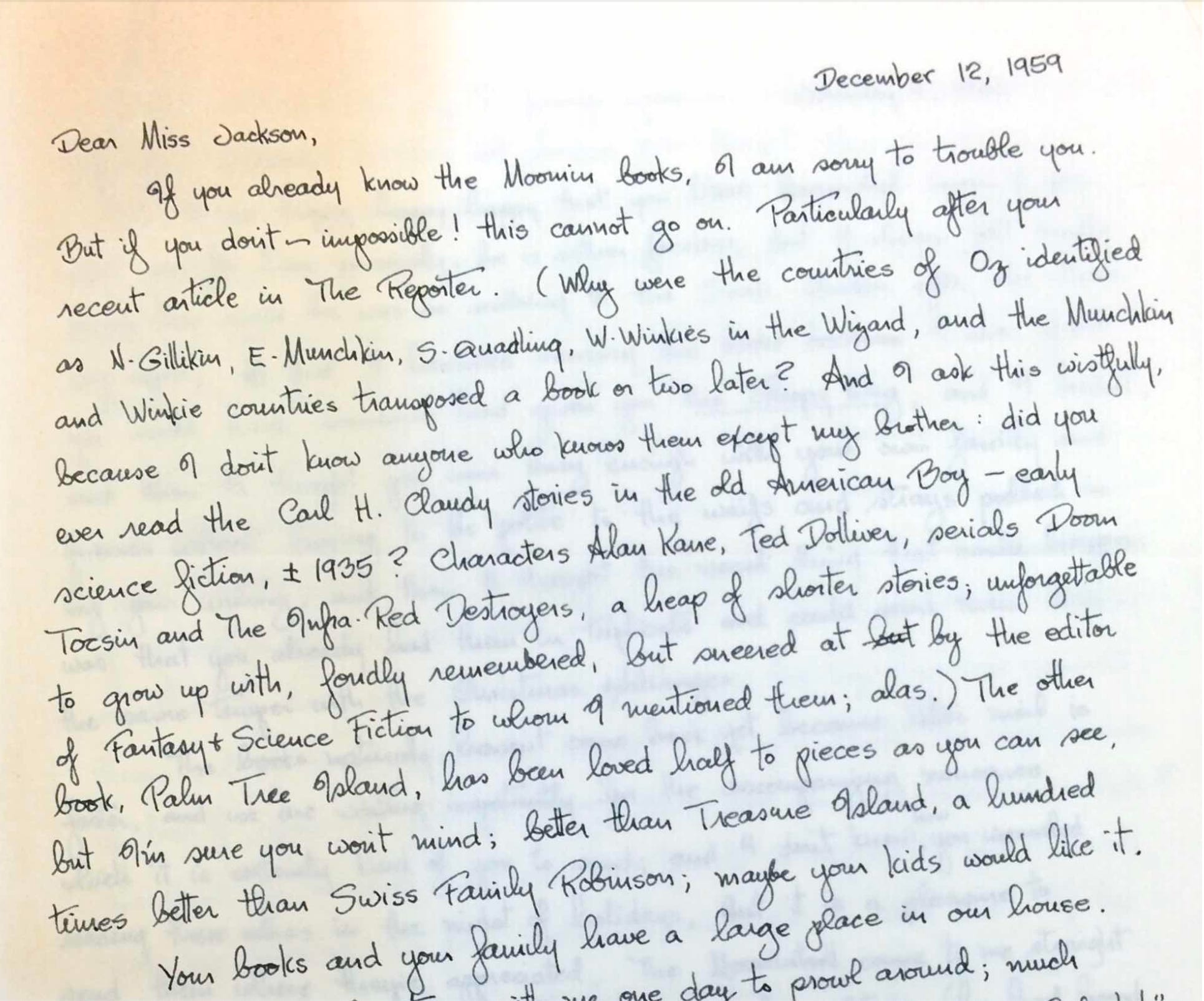
An intense correspondence ensued: a letter every month or so from December 1959 to January 1961. Shirley didn’t save drafts of her own letters, so I could only read Jeanne’s side, but her responses made clear what the exchange covered: family life (both women had four children), recipes (one involved canned grapefruit slices frozen in gin and served on toothpicks), and much talk about books: Tolkien, Dylan Thomas, children’s literature. There were also tantalizing details about We Have Always Lived in the Castle, which Shirley had begun writing around the same time as the correspondence started.
I closed the folder knowing I had to find Shirley’s letters to Jeanne. Shirley’s diary-keeping was sporadic; with few exceptions, the only substantive letters of hers that still exist are to her parents, and these touch only briefly on her writing. Letters about her work on Castle, her last completed novel, would be invaluable.
A Google search turned up an email address for Jeanne’s oldest daughter, who remembered the correspondence well—one of Shirley’s children had even visited the family in Baltimore. But after Jeanne’s death, only a year earlier, most of her possessions had gone into a dumpster.
I was saddened but not surprised. A hazard of women’s biography, I was beginning to learn, is that one’s subject tends to correspond with other women, whose papers often go unpreserved. I kicked myself hard for not having come upon the letters sooner, resolved to interview the daughter at some point about her mother’s connection to Shirley, and moved on.
A year or so later, the daughter wrote to me again. A bungalow Jeanne had owned in the Pennsylvania countryside was about to be sold. She had used an old barn on the property to store papers. Could the letters be among them?
Those words galvanized me. Somehow I knew Shirley’s letters were in that barn. We arranged to meet at the house—a four-hour drive from my home in Brooklyn—the following day.

The barn held a lifetime’s worth of detritus: old toys, clothing, knickknacks, and box upon box of newspapers, magazines, and letters. We were soon covered in dust and dirt. Mice had chewed through many of the boxes and left their droppings in others. Hours of searching turned up letters from friends and family members, but nothing from Shirley.
Jeanne’s daughter had to leave, but I decided to check into a nearby motel and continue the search the next day. There were at least a hundred more boxes. I couldn’t give up, knowing that the letters could be in one of them.

Feeling like Hercules before the Augean stables, I begged a friend who lived nearby to come help. By the time she arrived, I had already spent the morning in the barn with no luck. At the sight of her car, I collapsed on the grass, ready to give up.
My friend took a hard look at the building. “What’s in the front?” she asked.
“I don’t know,” I admitted. Jeanne’s daughter thought the letters would be in the back, so I hadn’t even looked.
We opened the door—which was unlocked—to a room strewn with more boxes and old furniture. In a corner was an ancient wooden filing cabinet. With some difficulty, we jiggled open the heavy top drawer.
My friend reached inside and pulled out a letter. I would have recognized it anywhere—typed pages on Shirley’s signature yellow paper.
It is not an exaggeration to say this felt like a miracle.
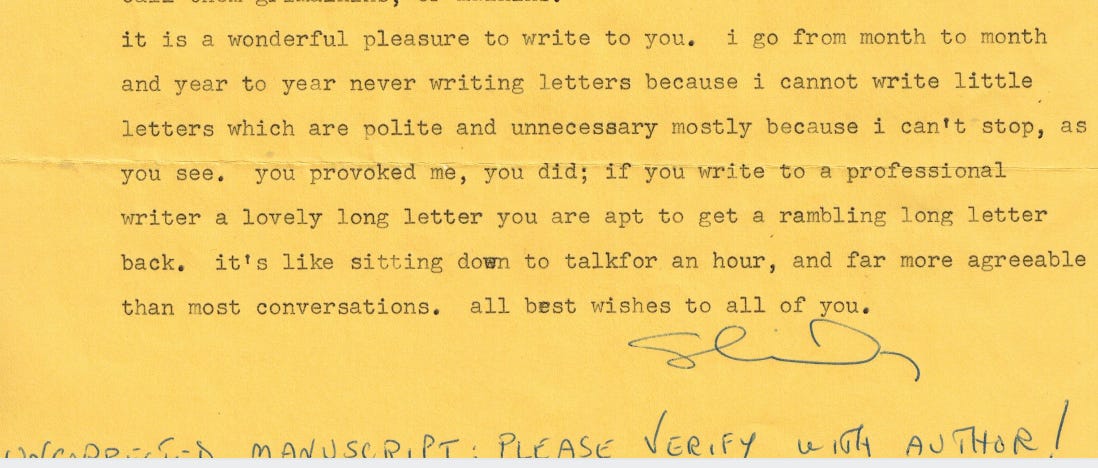
The drawer held fifteen letters, totaling more than sixty pages, mostly still in their original envelopes, with postmarks—a big help, since Shirley rarely dated anything. They were every bit as extraordinary as I hoped they would be.
On both sides, the correspondence became personal almost immediately, moving from books to children, husbands, writing. “I have promised myself absolutely to begin a new book next Monday morning, after the children have gone back to school,” Shirley told Jeanne in her first letter. “That means that I must lock myself up in my cave for four dogged hours a day, and sneak a minute or so here and there for writing letters and making lunch (‘You will eat vegetable soup again today and like it; Mommy’s beginning chapter three’).” (This first, more formal letter conformed to conventions of capitalization, but Shirley soon abandoned those for her typical all-lower-case style, which you see above.)
As the friendship progressed—only through the mail; the two women would never meet face-to-face—Shirley did not hide the more difficult aspects of her life. She joked about her moods, calling herself “sharly (snarly shirley)” and “shurley (surly shirley).” She complained about the isolation of North Bennington, Vermont, “with no trains and only an occasional nasty bus and roads not fit to travel on most of the time, so we are forced to find all our social life in one small college community.” And she wrote at length about her difficult marriage to Stanley Edgar Hyman, whom she described as “professor of literature at bennington college, vindictive winner of bets, poker player, writer of profiles for the new yorker, stern bearded disciplinarian, who will not read [The Haunting of Hill House] because he is mortally afraid of ghosts.”
At first, Shirley presented their family life as quirky but happy, full of inside jokes and private games. But soon a note of melancholy crept in. Stanley refused to enter her office because her books were not alphabetized and her shades were always crooked. He begrudged “every minute” she spent on anything other than writing fiction or magazine articles to sell, and once “in a fury figured out that considered in terms of pure writing time my letters are worth forty dollars a page.” And her haphazard working habits irritated him:
he sits down at the typewriter and says today i will write ten pages with half an hour for a cigar after lunch and today he writes ten pages and on tuesday he writes letters . . . and answers all the letters he has gotten since last tuesday and on sunday he files everything. . . . so when he sees me spending a Working Day making a doll house out of an old carton he gets very nervous. or sometimes i look at pictures of old houses or sing to myself or sit on the back steps telling myself stories and stanley frets.
Jeanne identified strongly with Shirley. Evidently brilliant, she had attended Oberlin College and Johns Hopkins University, taking courses in English, mathematics, and botany, but had given up her studies to marry and raise children. Her husband, an engineer, worked long hours, and she often broke off her letters in order to tidy the house before he got home: “Of course I will meet him smiling.” He, too, believed that time she spent writing or reading was time wasted. “What am I doing reading the Sunday papers? (It’s Sunday.) Why am I not washing fingerprints off the woodwork and vacuuming spiderwebs off the ceiling? . . . What are women for, anyway?” He had made her give away her piano—“House wouldn’t hold both it and play pen and we’re not giving the baby away”; she couldn’t even have a record player. She wouldn’t leave him, at least partly because she suffered from depression and depended upon his stability (“he solidifies the atmosphere”). But when Shirley described how she had spent part of the previous summer driving around by herself in her car, Jeanne felt “purest saturated envy. . . . I want loneness, no kids, no responsibilities but me, or nothing [no writing] comes. Except a couplet now and then put down on kitchen paper, and one of those got put out by mistake for the milkman.”
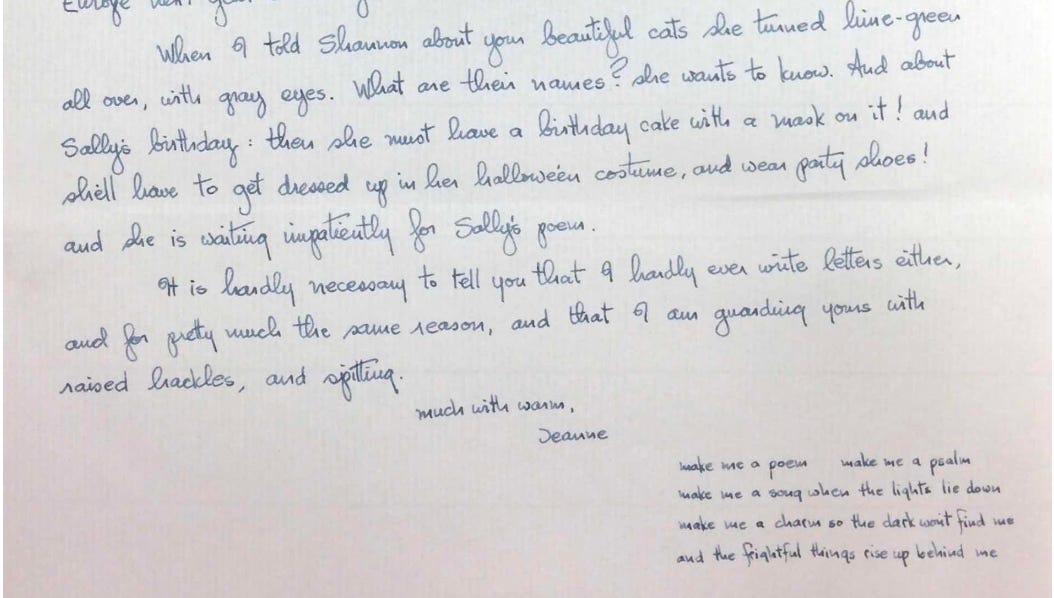
How I felt for them both: Jeanne, who had set aside her gifts for a husband who didn’t value them, and Shirley, brilliant and tormented, close to abandoning Castle, which would be her last completed novel. Their friendship was so unlikely—how often does a real relationship grow out of a fan letter?—and apparently brought so much joy and solace to them both.
Then, after about a year, the correspondence started to fizzle. First it was Shirley’s fault: as her work on Castle finally got underway, she had less time for letters.
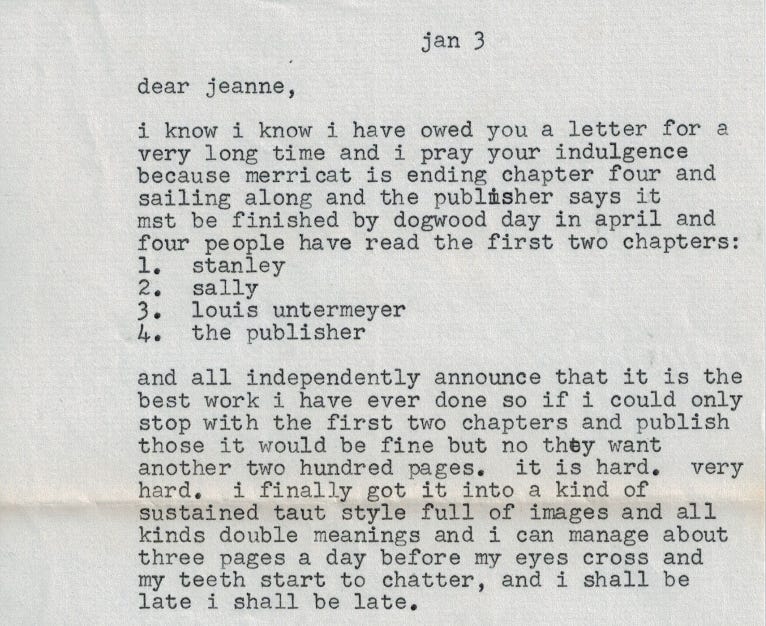
Then it was Jeanne who abruptly stopped writing. Shirley was first puzzled, then hurt. She wrote a few more times and sent a copy of Castle when it came out. But Jeanne never wrote again, not even to acknowledge the gift.
When Shirley died a few years later, in 1965, Jeanne clipped her obituary from The New York Times and put it away in the same folder in which she kept the letters. And there the folder remained for almost 50 years.
I can’t imagine what my book would have been like without these letters. They transformed my understanding of Shirley’s writing process for Castle, which I describe in great detail in Chapter 16, “Steady Against the World.” They added texture to my portrait of her marriage to Stanley. And they revealed the depth of her loneliness, through her willingness to pour out her heart in the mail to a complete stranger.
Some time later, telling another biographer the story of how I found the letters, I said, “I can’t believe how lucky I was.”
My colleague shook her head. “You made your own luck,” she told me. “Those letters didn’t find themselves. You asked the questions that needed to be asked. And you knew where to look.”
Well, it was actually my friend who figured out where to look. So I would add: I knew to ask for help when I couldn’t face that barn full of papers alone.
Have you ever had a moment of “making your own luck”—a time when persistence (or sheer stubbornness) led to a unexpected discovery or breakthrough? I'd love to hear your stories in the comments.
What I’m reading
I have a review of British writer Fiona Mozley’s new novel, Awake Awake, in the latest New York Times Book Review. It’s one of the most mysterious, nearly opaque books I have read in a long time—in fact, it reminds me a little of Jackson’s Hangsaman, in that I was genuinely unsure whether certain events were real or figments of the narrator’s imagination. Read my review here.
Where I’ll be
October 25, 11 a.m.–1 p.m. Eastern (online): I’m teaching a craft seminar called “Everyone’s a Critic.” Here’s the description:
We’ve all finished a book, walked out of a movie, or wrapped up a series and immediately thought, “I have some thoughts on that.” But turning those raw opinions into a sharp, propulsive piece of writing that readers love—and editors want to buy—is its own craft.
In this craft seminar, longtime critic Ruth Franklin takes you on a deep dive into the practical mechanics of criticism. We’ll break down the anatomy of a brilliant review, learn how to weave in deep analysis without getting trapped in plot summary, and discuss how to pitch editors with an angle that ties into the current cultural moment. Whether you want to write for legacy publications, elevate your newsletter, or just build a more authoritative voice, this workshop will give you the tools you need.
Sign up here.
Great essay. Looking forward to reading your book! You asked for stories, so here's mine: when I was working on my dissertation on Louis Kahn (American architect), I befriended his first "mistress" Anne Tyng, to try to get more information on a period in his artistic development that all the male scholars had pooh-poohed and ignored. After several months of interviews, Tyng read aloud to me the letters Kahn had written to her in the early 1950s, when she self-exiled to Rome to carry their daughter to term (Kahn was married to someone else, and Tyng raised their child as a single mom). Tyng stood in her little kitchen in a townhouse in Center City, Philadelphia, and read me Kahn's letters ("Dearest Annie"), tears streaming down her face. She'd never shown them to anyone -- now they're published-- and it led to my arguing, successfully, for a complete reassessment of Tyng's influence on that period of Kahn's work. A small triumph, but important to me.
As a fan of A Very Haunted Life and a nearly lifelong reader of Shirley Jackson, I’m grateful for this essay. It’s personal for me. My mother was a writer and a brilliant teacher of literature. I watched her teach “The Lottery” to a night school class at a nearby air force base; those men practically levitated with astonishment. I also witnessed my mother’s long epistolary friendship with a fan, an aspiring writer who consoled me after my mother’s death. I have these letters (Mother kept carbons). What will future biographers do without letters?