
How do dinosaurs understand the Holocaust?
Remembering Jane Yolen, 1939–2026.

I first came to Jane Yolen’s work as a parent of young children via her classic picture book How Do Dinosaurs Eat Their Food? The book quickly became such a bedtime staple that I can still recite most of it. “How does a dinosaur eat all his food? Does he burp, does he belch, or make noises quite rude?” It has such staying power not just because of its charming concept—it humorously lays out the rules of family and social life by depicting dinosaurs as misbehaving toddlers to be gently corrected—but because it is deeply consoling to both adult and child. The dinosaur will stop throwing his food on the floor and turn into a delightful dinner companion who “tries every new thing, at least one small bite.” The parent will somehow keep her cool until this happy day arrives.


I was astonished a few years later to learn later that Yolen, the author of the Caldecott-winning Owl Moon as well as numerous other books for children, had also written The Devil’s Arithmetic (1988), a very powerful Holocaust novel for middle-grade readers that won the National Jewish Book Award. When the book opens, Hannah, the book’s protagonist, is a rebellious American preteen who doesn’t want to go to a Passover seder hosted by her survivor relatives. Her grandfather frightens her by yelling at the TV whenever footage of the camps appears; once, when she used a ballpoint pen to ink a copy of his tattoo on her arm, he screamed at her in Yiddish.
At the seder, Hannah opens the door to welcome the prophet Elijah—a key moment in the ritual—and finds herself transported to Poland in 1942. She’s now Chaya, the niece of Gitl and Shmuel, siblings who have taken her in after the death of her parents. At first, Hannah/Chaya thinks she’s stumbled onto a movie set or become the victim of an elaborate prank. But when guests arive for Shmuel’s wedding to Fayge, a rabbi’s daughter from a nearby village, Nazis are waiting at the synagogue to transport them all for “resettlement.” To Hannah’s frustration, no one will listen to her warnings, not even the rabbi:
“The men down there,” she cried out desperately, “they’re not wedding guests. They’re Nazis. Nazis! Do you understand? They kill people. They killed—kill—will kill Jews. . . . Six million of them! I know. Don’t ask me how I know, I just do. We have to turn the wagons around. We have to run!”
Reb Boruch shook his head. “There are not six million Jews in all of Poland, my child.”
Yolen renders Hannah’s plight in language and imagery that make sense to younger readers: the boxcar in which she’s packed reminds her of the subway during rush hour. But the author does not condescend by evading the awful details. The stench of vomit and excrement in the train car grows thick; a child dies in its mother’s arms. When the train finally stops, after four days, Hannah is so thirsty that “she could feel her tongue as big as a sausage between her teeth.” Her head is shaved; she receives a tattoo. A girl introduces her to the camp rules, the first of which is “One does not ask why.” When she is finally restored to her real life in America, she returns with a new appreciation for her relatives’ stories.


At a convention for librarians soon after its publication, The Devil’s Arithmetic was attacked by an editor at a children’s-book journal who asked why readers should waste time on Yolen’s fiction when true chronicles, like Anne Frank’s diary, were available. To resort to fantasy, he said, trivialized the Holocaust. The science-fiction writer Orson Scott Card defended Yolen, arguing that her book might actually be more powerful for its audience than Anne’s diary—both because Yolen’s protagonist is a typical American preteen and because the diary ends “where the true horror begins.” The Devil’s Arithmetic allows readers to imagine themselves in Hannah/Chaya’s place, Card wrote, in “the most terrible part of the most terrible crime mankind is capable of.”
Yolen, too, in an article describing her rationale, emphasized the importance of personal identification. “Thrust a young reader back into the heart and mind of someone his or her own age. . . . Let that protagonist ask the questions our young people all want to ask. . . . The answers they get from the folk in the story will astound them, shake them into new awarenesses, really let them remember and be part of history.” When children are toddlers, they can identify with dinosaurs; as they grow older and more sophisticated, we can ask more of them.
Part of the difficulty of writing about the Holocaust for children is the irreconcilable tension between the subject and our assumptions about children’s literature. To write about the Holocaust realistically, in all its horror, violates the tacit promise of writing for young readers: not to disturb them too deeply. At the same time, a story that won’t keep young readers up at night contradicts the historical reality. Yolen’s fantastical framing device is an ingenious solution to the problem. Not only does it prevent the atrocities of life in an extermination camp from overwhelming her young readers, it also speaks to the painful paradox all of us in the post-Holocaust world feel: how to be an adequate witness to something we ourselves didn’t experience. If we can’t time-travel ourselves, reading is the next best option—and the only possible consolation.
I wrote about Yolen’s Holocaust writing, which also includes two other young adult novels, for The New Yorker back in 2018. In the piece, I tried to parse what separates the best Holocaust children’s writing from more cavalier specimens like The Boy in the Striped Pajamas, a deliberately unrealistic work that coyly declines to elaborate on its fictional methods. “Not only are her Holocaust books extensively researched, and their departures from historical fact scrupulously noted, but her fantasy framing devices also reflect a kind of imaginative humility about the difficulty of ‘truly understanding,’” I wrote then.
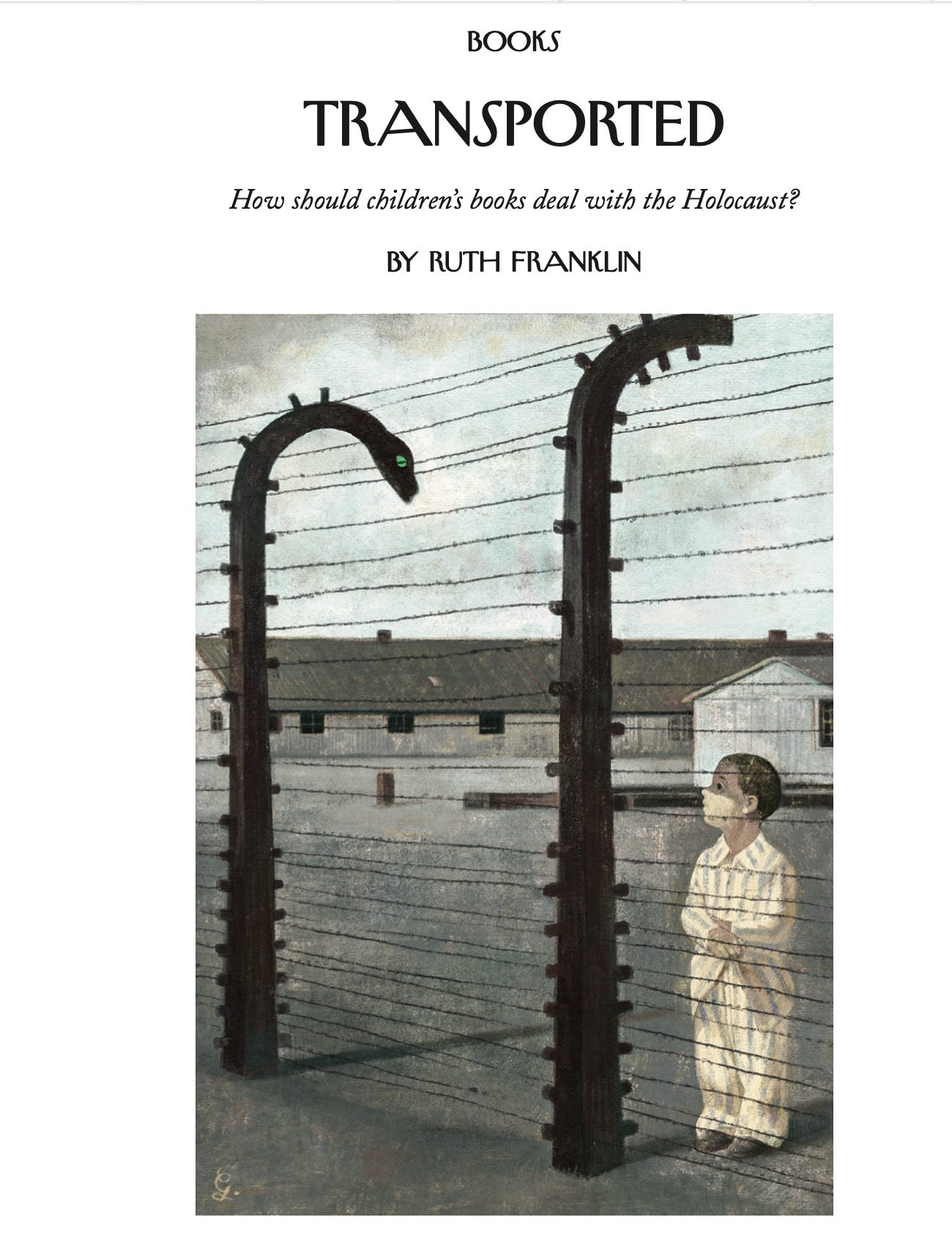
But looking back at the piece now, what haunts me most is the conversation in which Hannah tries to warn the rabbi about what is going to happen to his community:
“No, Rabbi, six million in Poland and Germany and Holland and France and . . .”
“My child, such a number.” He shook his head and smiled, but the corners of his mouth turned down instead of up. “And as for running—where would we run to? God is everywhere. There will always be Nazis among us.”
Yolen died last week at the age of 87. May her memory be for a blessing.
Have you read any of Yolen’s books? Which ones stayed with you most? Let me know in the comments.
Where I’ll be
Online, July 25, 1-3 p.m.: I’m hosting a single-session workshop, “Write Like a Mother: Finding Your Voice After Having Children.” It reframes motherhood as a creative opportunity rather than an obstacle, as well as offering practical strategies for organizing time and work. We’ll look at passages on parenting and art from brilliant mother-writers like Shirley Jackson, Audre Lorde, and Ursula K. Le Guin, and discuss how to keep our work moving forward when life is unpredictable and exhausting. Sign up here.
In person: New York, July 26, 2 p.m.: I’ll be in conversation with my friend Heather Clark, author of Red Comet: The Short Life and Blazing Art of Sylvia Plath and, most recently, the novel The Scrapbook, which deals with the aftermath of the Holocaust two generations later. Details here.
What I’m reading
Apropos the discussion of AI in my last newsletter, I devoured Kazuo Ishiguro’s Klara and the Sun, which imagines a not-far-off future in which parents acquire AI robots as companions for their children. I was intrigued by the novel’s use of an AI as the narrator, but I came away with a sense of the book as a kind of paler echo of his Never Let Me Go—which, in fairness, is probably one of my top ten of the 21st century.
Thirty years later, I still vividly remember reading The Devil's Arithmetic in sixth grade in the late nineties--it was so powerful.
i always liked jane yolen, especially her poetry. thanks for writing