
After such knowledge
How should we commemorate the enslaved people who built America?

The hands are taller than a person, each fingernail as big as a dinner plate. Their cast-bronze surface is wrinkled, weathered, showing that they belong to a person who has performed hard labor. They sit open, cupping the air around them, in a gesture that might be a plea, or an invitation. Come here. Closer.
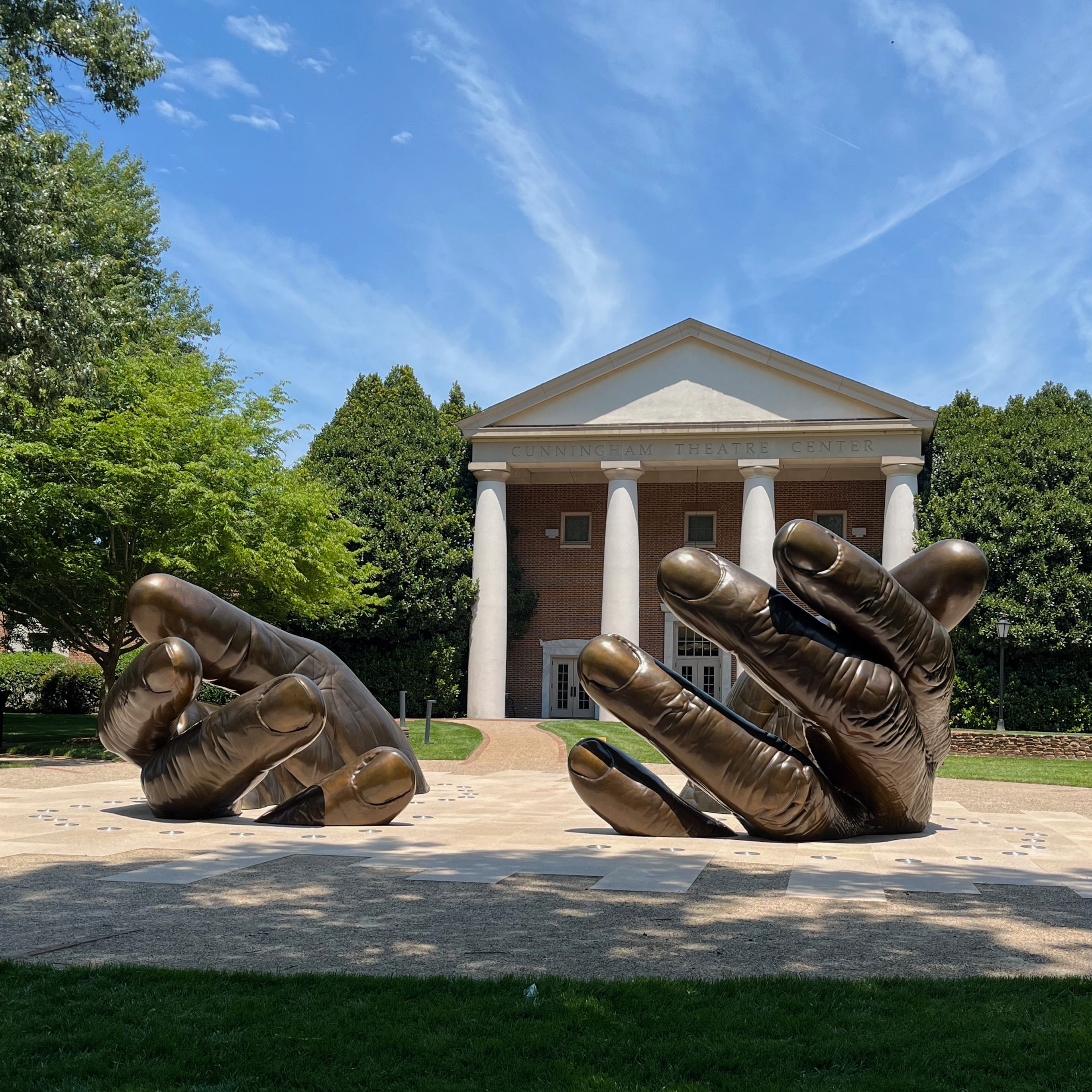
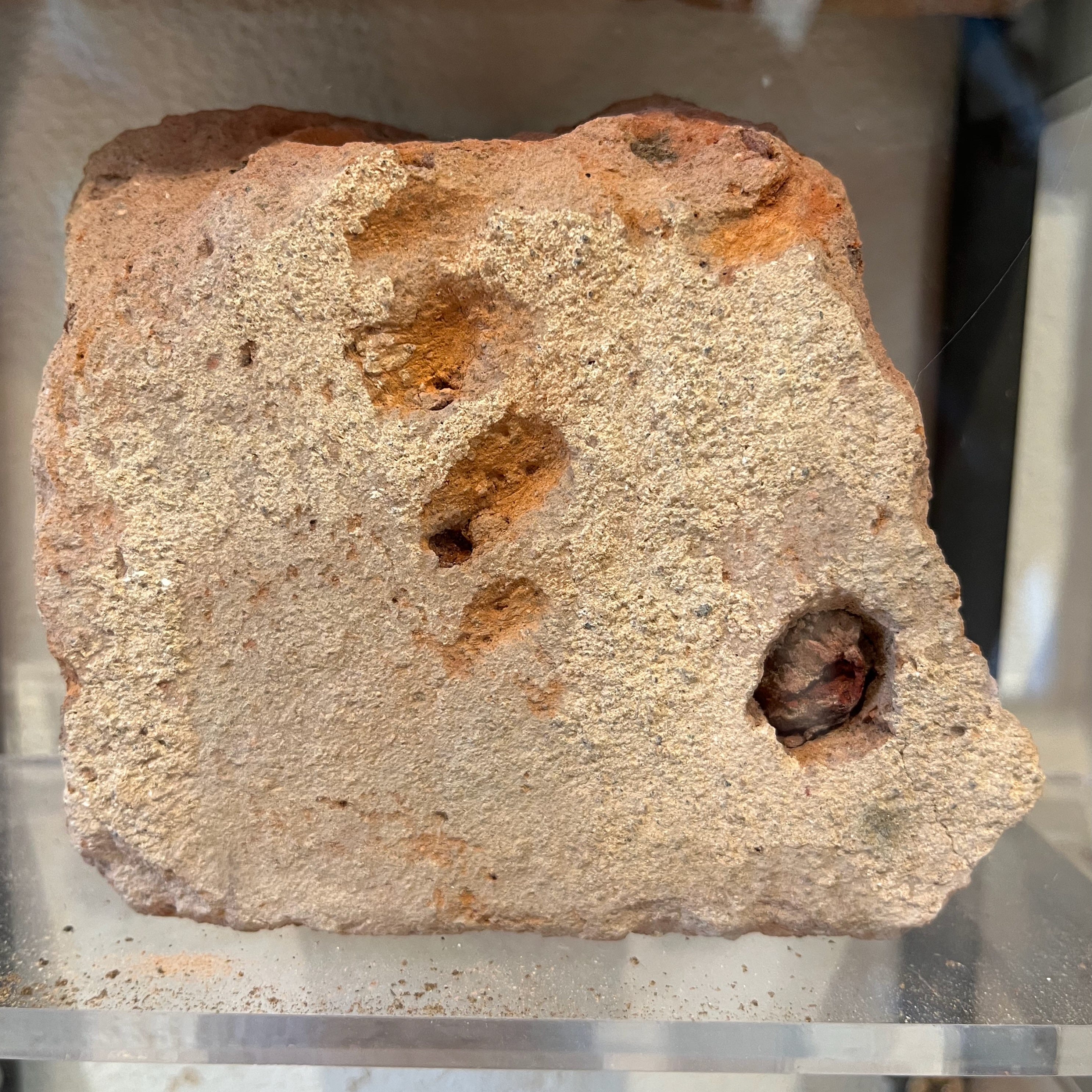
This sculpture, by Hank Willis Thomas in collaboration with Perkins&Will, is called “With These Hands: A Memorial to the Enslaved and Exploited.” It sits on the campus of Davidson College, a small, elite liberal arts school in central North Carolina, opposite one of the oldest buildings on campus—one built by enslaved people. That building now holds a small museum exploring the ways in which the college benefited from slave labor. On display are bricks in which the fingerprints of the enslaved people who created them are visible: deep, tactile holes. Exhibits seek to reconstruct the life stories of those people.
Over the past year, as part of a project exploring Mark Twain’s legacy in America today, I’ve traveled around the country visiting sites that commemorate Black history, such as the Legacy Museum in Montgomery, Alabama; the National Museum of African American History and Culture in Washington, D.C.; and the Niagara Falls Underground Railway Heritage Center. I began this journey shortly before the Trump administration ordered a review of exhibits discussing slavery at national parks and other institutions, including the Smithsonian, which it accused of trying to “undermine the remarkable achievements of the United States by casting its founding principles and historical milestones in a negative light.”
During these travels, I’ve seen some powerful historical exhibits and works of public art, which I plan to share more about in my newsletter over the coming months. But nothing had the same effect on me as the sculpture at Davidson. I sat near it for the better part of an afternoon, looking at it from all angles, watching visitors pose for pictures next to it as the light softened and shadows deepened. At night, illuminated from below, it glows.
The sculpture stands in honor of not only the enslaved people who built those early buildings, but all the Black workers, “known and unknown,” who contributed to the life of the college from its founding in 1837 through the Jim Crow years: laundry workers, gardeners, groundspeople, cooks. As poet Clint Smith—a Davidson alum and the author of the remarkable book How the Word Is Passed—writes in a poem he read at the sculpture’s unveiling last fall:
With these hands they constructed buildings they were not allowed to enter,
they cooked food they were not allowed to eat,
they washed clothes they were not allowed to wear.
How did I get here from Mark Twain? you might be wondering. Over his lifetime, Twain underwent a remarkable personal journey. Born into a slave-owning family in Missouri, he eventually married Olivia Langdon, daughter of leading abolitionist Jervis Langdon, and committed himself to the fight for equality for Black people.
On a visit to Yale in 1885, soon after the publication of Adventures of Huckleberry Finn, Twain met a young Black law student named Warner T. McGuinn who was struggling to support himself with part-time jobs. Twain was impressed with both his brilliance and his work ethic. “I do not believe I would very cheerfully help a white student who would ask a benevolence of a stranger, but I do not feel so about the other color,” he wrote to the dean of Yale Law School, offering to pay some of McGuinn’s fees. “We have ground the manhood out of them, & the shame is ours, not theirs; & we should pay for it.” As Ron Chernow puts it in his recently published biography, “Twain had devised his own form of racial reparations.”
On my own journeys around Trump’s America, I’ve been thinking about the forms reparations can take. Toward the end of their lives, my grandparents fought for and received financial compensation from the German government for their sufferings in the Holocaust. As I’ve written here before, I regard the Polish passports I acquired for myself and my children, giving us the right to live and work in the European Union, as restitution for the crimes committed against my family.

What is required to appropriately acknowledge our crimes against the Black people whose fingerprints are embedded in the bricks of our country’s buildings? Many years ago, the great German writer W.G. Sebald gave a speech in which he described literature as a way of honoring “the memory of those to whom the greatest injustice was done … an attempt at restitution over and above the mere recital of facts.” Places like the Legacy Museum (which goes far beyond the work of a typical museum) can serve this purpose. So can a sculpture like “With These Hands.”
Meanwhile, as Heather Cox Richardson reminds us, today is the 72nd anniversary of the Supreme Court’s decision in Brown v. Board of Education declaring racial segregation in schools unconstitutional. Yesterday in Alabama, thousands of Americans protested in Selma and Montgomery against the Court’s recent decision weakening the 1965 Voting Rights Act.
Has your community made efforts to reckon with the painful aspects of its history? Let me know in the comments.
Where to find me
I’ve been doing a radio and podcast tour to promote the paperback launch of The Many Lives of Anne Frank. Some highlights: The Shelley Irwin Show, The Roundtable with Joe Donahue, The Lowdown with Ira Wood. More to come!
What I’m reading
Nothing Tastes as Good by Luke Dumas, a horror novel that doubles as a smart and funny parable of diet culture. A sweet young guy who has always struggled with his weight signs up for a trial of a new drug called Obexity, which offers miraculous weight loss—as long as he can tolerate some extremely disturbing side effects. I’m working on an essay that examines recent books about fatphobia and tries to answer the question of why thinness remains so persistent as an ideal. Stay tuned …
I hadn't known about the "With These Hands" sculpture. I find it beautiful and very moving. Thank you for having shared it. One of my favorite exhibitions commemorating the enslaved people who built America is Fred Wilson's "Mining the Museum" in the Maryland Historical Society, in which Wilson was given free run of the collection to rearrange, reorder, and recontextualize in ways that highlighted the previously hidden history of the enslaved people in the region. An exhibit entitled "18th-century metal working" for example, included ornate sterling silver tea sets, along with a set of heavy iron slave shackles--connecting the enslaved people who kept the tea set shining with the normally uncontextualized display of opulence. But "With These Hands," with the gigantic hands in front of the house they likel built, takes the juxtaposition to a new level. I'm glad to know about this!
Ruth- Wonderful piece, and I didn't know about the incredible Davidson sculpture. I was the visiting writer there in the fall of 1992--which was, thank heavens, many lifetimes ago for the community. Sounds like visitors encounter a very different place these days. My first Sunday there, the KKK marched through the town and held a "rally" at a parking lot across from the college. THere were more horrified observers than Klan people (20 marchers, 25 observers--and yes, the KKK had a permit). The hatred spewed in the parking lot was old school Klan talk. I later learned that the nearby town of Mooresville was the headquarters of the KKK in NC. Don't know if this is still true or was then. (And I do NOT mean at all to implicate Davison College in this event!!)
In 1992, the college was still still newly co-ed, to the displeasure of some of the old boy trustees, and not a welcoming place for gay students, as one left the college mid-year after being harassed and not given support by the administration. I had young women students who did not want to be in co-ed dorms because they felt they had to get dolled up whenever they left their rooms--because they'd encounter males. Faculty found all of this bigotry and sexism abhorrent, and we did our best to offer other perspectives and models to the students!
The sculpture and museum sound like evidence of a different place today. How to commemorate enslaved people who built the country? Give their descendants back their voting rights--a good, if now aspirational place to start. Thank you for sharing your travels, observations, and questions.